Residential Immersion · DIC Hub, IIT Hyderabad, India · Middle East 2026
Design Thinking, Entrepreneurship & Innovation.
A fully residential innovation immersion at the Design Innovation Centre, IIT Hyderabad, India, where high-school students learn to read complex systems, find real opportunities inside them, and build a venture they defend before a live jury. Anchored by The Institute of Human-Centred Design.

01 · What is this programme
Real rigour. Real problems. Real ventures.
Design thinking is not a subject to master; it is a way of thinking to adopt. Over five days, students learn to question deeply, understand the people they are solving for, and turn an insight into something they can build and defend.
It applies equally to scientists, entrepreneurs and students, because its foundation is not a specific output but a way of thinking.

01
Think like a designer
Understand a problem and the people at its centre before reaching for a solution.
02
Build like a founder
Shape that understanding into a venture that can survive and reach people.
03
Test like a scientist
Treat every idea as a hypothesis to prove with real people, not an opinion to defend.
The five-day journey
From idea to incubation, in five days.
The week moves from pre-incubation — finding a problem worth solving — into incubation, where a validated idea becomes a venture, and closes at a live startup summit.
Days 1–2
Pre-incubation
Understand the system.
Days 3–4
Incubation
Build and test a venture.
Day 5
Startup summit
Pitch and Grand Jury.
| Day | Focus | What happens |
|---|---|---|
| Day 1 | Discover & map the system | Explore a real theme, map the wider system around it, and learn to look before leaping to a fix. |
| Day 2 | Empathy & field research | Observe, listen and ask real questions to define the problem worth solving. |
| Day 3 | Prototype in the Makers Lab | Generate many ideas, then build and stress-test a working prototype with hands-on tools. |
| Day 4 | Business plan & industry immersion | Shape the idea into a venture and plan, with a guided visit into the IIT innovation ecosystem. |
| Day 5 | Deliver & the Grand Jury | Pitch and defend the venture before a jury of external practitioners and IIT faculty. |

The intellectual anchor
Rooted in systems thinking.
This immersion is anchored in the Indian systems-thinking tradition taught in the country's leading design and technology institutes: a way of seeing a whole situation, its parts and the relationships between them, before designing into it. That tradition was pioneered by Prof. M P Ranjan and is documented on the Design Concepts & Concerns blog.
Students don't just learn a toolkit; they learn a lineage, and carry it into every problem they meet next. The same systems lens taught to design postgraduates, introduced to high-school students in a language they can use.

Pre-incubation
Find a problem worth solving.
Every venture begins as a response to a problem. Before building anything, students learn to sit with a problem long enough to understand it properly. Vague problems lead to vague solutions; sharp problems lead to sharp thinking.
01
Discover broadly
Gather everything about a subject without judgement — what exists, what people say, what frustrations repeat.
02
Understand the system
Zoom out to the social, economic and environmental structure a problem sits inside, then back in to the people.
03
Define sharply
Name who is affected, what the real difficulty is, and why it matters — in one clear sentence.
Turn your problem into a "How Might We" question — the trick designers at IDEO and Google use to turn a problem into an invitation for ideas.
Tip from the studio

Incubation · the student startup studio
Turn an idea into a venture.
With a well-defined problem in hand, students enter the studio: developing many possible responses, building the strongest into a prototype, and shaping it into something they can explain, defend and pitch. This is where a design thinker and a young founder become the same person.
01
Develop & prototype
Explore genuinely different directions, then build a low-fidelity model to test and react to — not a polished final product.
02
Test before you launch
Validate assumptions with real people — focus groups, A/B tests and an MVP — before committing time and resources.
03
Pitch with conviction
Communicate the idea clearly enough that someone outside the team understands why it matters and how it works.

Understanding a problem and building something for it are two halves of the same instinct.
From idea to plan
Every founder writes it down.
Many ideas sound compelling in conversation but fall apart the moment they are written down, because writing forces you to answer questions a conversation lets you skip. Students learn to move from "this is a good idea" to "here, precisely, is how it works, who it serves, and how it survives."
- 01What problem are you solving, and for whom?
- 02What is your solution, specifically?
- 03Who else is solving this, and what makes your approach different?
- 04How will people find it, and how will it reach them?
- 05How is it paid for — and what does the idea genuinely need versus what is merely convenient?
Funding and resourcefulness: not every good idea needs significant funding to begin. Knowing the difference between what an idea requires and what is merely convenient is, itself, a design-thinking skill.
The method
One method. Three lenses.
To keep design thinking practical rather than abstract, the cohort returns again and again to three questions of every idea they examine, from first problem to final pitch.
01
Usability
Who is this for, can they access it, and does it genuinely work for them in practice — not just in theory?
02
Human-Centred Design
Design with people, not around them — understanding needs and constraints before proposing a solution.
03
Sustainability
Who benefits, who is affected, and what the broader consequences might be — today and over time.
The startup summit
Your system. Your solution. Their verdict.
The week closes at a live startup summit. Opportunities found in the system are converted into tangible ideas; MVPs are tested and then presented to a final jury of external jurors and IIT Hyderabad, India faculty, judged to international design-school standards. It is the moment a five-day project becomes a founder's first real pitch.


Industry immersion
Inside a living innovation ecosystem.
Students step out of the studio and into the real thing — an incubation centre, working labs, and startups across the Hyderabad ecosystem, seeing how design thinking operates under real pressure.
T-Hub Hyderabad
Startup incubator — startups and founders at scale.
Global product companies
Design systems and product culture inside companies such as Microsoft and OPPO.
Incubation centre & labs
Where early ventures are built, funded and supported.
Live startups
Meet founders and see how ideas become working companies.
Specific industry and startup visits are confirmed per cohort, subject to availability of dates from the external host organisations.
02 · Where is this programme
A 600-acre township, a marvel of Indian education.
IIT Hyderabad's campus is a world-class township master-planned with the University of Tokyo, one of the finest environments Indian higher education has built. For five days it becomes the students' world.

8-doctor service hospital
Full campus medical service on site, round the clock.
Pools & indoor stadiums
World-class sporting and swimming facilities across the township.
Lecture halls & library
The Knowledge Well library and world-class teaching spaces.
Astronomical centre & labs
Research labs and an astronomy centre — science made visible.
The Design Innovation Centre
DIC Hub, IIT Hyderabad, India.
The Design Innovation Centre (DIC) is a node inside IIT Hyderabad's Department of Design, with a mandate to spread an innovation-driven curriculum across the country. By last year's CEED admission data, it stands among the most preferred design schools in the IIT ecosystem.
This immersion is part of that mandate: an opportunity for students and teachers to experience IIT first-hand, and to see what a national and global education and innovation future can look like.
The Institute of Human-Centred Design, incubated at DIC Hub, IIT Hyderabad, India, co-delivers the programme.

Life on campus · fully residential
Arrive at the airport. We take it from there.
The programme is fully residential and fully curated. From the moment students land, they are inside the IIT Hyderabad, India campus — looked after, fed and mentored — so families can send them with confidence.
01
Airport pickup
IIT arranges pickup for students directly from Hyderabad airport on arrival.
02
IIT Global Guest House
Students stay on campus at the IIT Global Standard Guest House for the full immersion.
03
Meals, care & campus
Food is provided through the IIT faculty and guest kitchen. A campus hospital, pools and stadiums are all on site.


The IIT Global Guest House
A comfortable base, right on campus.
An international-standard residence inside the campus itself. No daily commute: studios, labs, library, dining and sports facilities are a short walk away, and students stay together as a supervised cohort throughout the five days. Every meal is provided on campus, and a campus hospital sits minutes away. On campus · Full board · Supervised cohort · Medical service on site.
03 · Why this programme
A capability that pays back for years.
We are living through a moment when machines can produce answers at a speed no individual can match. What they cannot do is originate a question that has not been asked, or notice a problem that has not been named. That is exactly what this programme trains: the ability to ask a good question, look at a familiar situation and see it differently, and act on it.
Thinking for yourself, asking questions rather than completing tasks, and understanding a problem fully before acting on it — these are the habits that last.
You leave with
A credential and a body of work
A certificate from DIC, IIT Hyderabad, India, aligned to the IIT-DIC framework and validating real-world exposure and engagement inside IIT Hyderabad, India · A design portfolio built from your own week of work · A validated venture idea, a business plan and a defended pitch.
The experience
Learning inside a working centre
A residential cohort — students stay on the IIT campus · Small batches, mentored by senior faculty and practitioners · Learning inside a working design and innovation centre.
Where it can take a student
One programme. Three admission tracks.
Design thinking and entrepreneurship strengthen an application across design, engineering and management. Students leave with a portfolio, a verifiable credential and DIC alumni recognition that admissions panels in the UAE, India and abroad understand.
Design
The problem-framer's edge
Real design work — systems maps, research, prototypes — the evidence design schools ask for, and the aptitude UCEED and CEED test.
Engineering
A portfolio that speaks
Defining a problem and building a working prototype sets an engineering applicant apart.
Management
A founder's story
A validated venture, a plan and a defended pitch are the raw material of a standout management application.
- India · the IIT & IIM ecosystemIIT B.Des — UCEED · IITs — engineering · IIMs — IPM
- Global · leading universities & design schoolsHarvard · Yale · Wharton · Stanford · MIT · RISD · Parsons · Aalto · TU Delft · ETH
DIC alumni recognition
Completing the immersion brings a student into the orbit of IIT Hyderabad's Design Innovation Centre — a genuine early connection to the IIT–IIM innovation ecosystem in India, years before an entrance exam.
Future-ready learning
Design thinking, multidisciplinary learning and hands-on, experiential education sit at the heart of learner-centred strategies such as Dubai's Education 33 and India's NEP 2020. This immersion is exactly that kind of learning.
UCEED · CEED aptitude
Visual thinking, problem framing and creative reasoning are precisely what India's design-aptitude examinations — UCEED for undergraduate and CEED for postgraduate design at the IITs — set out to measure.
These pathways strengthen an application across design, engineering and management. They are an advantage a student earns, not a guarantee of admission to any institution named here.
Beyond the five days
An open door into the IIT ecosystem.
For the most promising projects, the programme is designed to be a beginning, not an endpoint. It connects genuinely innovative students to the pathways an IIT can open.
Apply to the incubation centre
Standout ventures may be invited to apply to IIT Hyderabad's incubation centre and, where selected, to draw on its funding and support ecosystem to take the idea further.
The Makers' Quota
An emerging pathway that encourages innovative students to keep following the path of innovation, with the aspiration that a strong project may, in time, support an application to IIT departments. An upcoming initiative to promote innovation among future IIT graduates.
These pathways are emerging and selective — offered to encourage the most innovative students, not guaranteed as an outcome of attendance.
04 · Who should attend
Built for students who want to build.
No design background required. No business idea needed. The immersion is built for curious, ambitious students in Grades 9–12, and for the teachers who want to bring innovation thinking back to their classrooms.
The curious builder
Loves making and tinkering — always asking "why" and "what if".
The future founder
Drawn to startups and real problems, and wants to test whether an idea can stand up.
The design / engineering / business aspirant
Considering an IIT B.Des, engineering, management or a global school.
The explorer
Still choosing between design, engineering and management — wants exposure to all three.
Teachers & schools
Educators who want to carry innovation pedagogy back into their classrooms.
No prerequisite
Grades 9–12, small cohorts. Just curiosity, ambition and the drive to build.
The anchor faculty
Led by the people who shape design pedagogy.
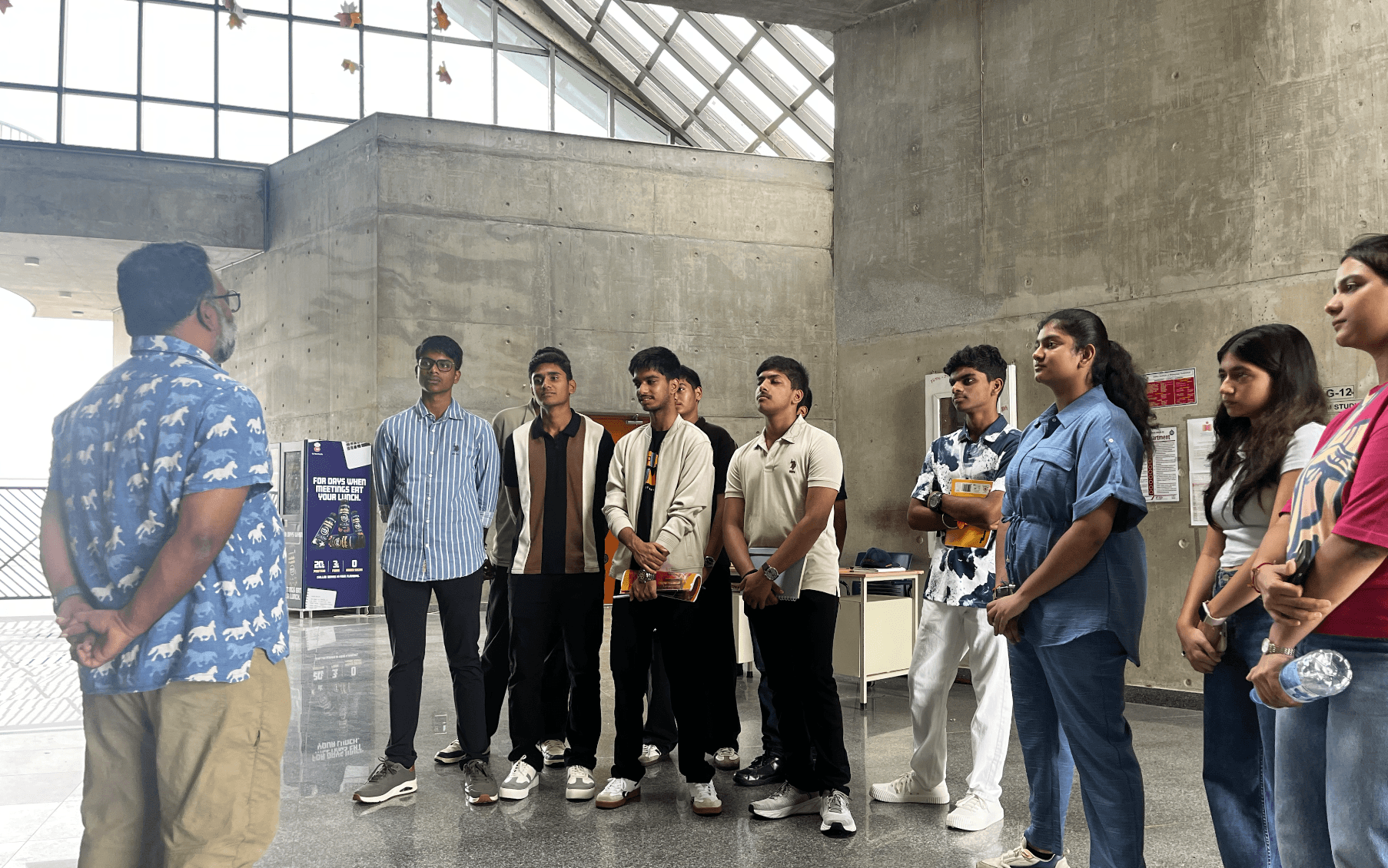
Every day is designed and led by senior IIT faculty, design educators and education leaders — the same people who teach the method to postgraduates. Five anchor faculty guide the cohort from first problem to final jury.

Dr Deepak John Mathew
Founding Board Member, HCD Institute · Professor, IIT Hyderabad, India · Nodal Head, DIC Hub

Elias V
Faculty, DIC Hub · Research Scholar, IIT Hyderabad, India

Jacinta Bell
Interaction designer · Fellow, HCD Institute · Researcher, DIC Hub
Co-author of a design curriculum book for high-school students- Munwar KhanIIT Bombay alumnus · DGM, Head of Design, OPPO MobilesAnchor faculty · industry
Inside the immersion
Five days at DIC Hub, IIT Hyderabad, India.


05 · How you can attend
Four steps, from enquiry to arrival.
Schools can run a dedicated cohort for their own students; individual students can join an open batch. Either way, the path is simple.
01
Enquire
A school or parent writes to uae@hcd.institute.
02
Choose a cohort
We confirm dates and batch size — a dedicated school cohort, or a place in an open batch.
03
Register & prepare
Students confirm their place and receive a pre-immersion brief and travel details for Hyderabad.
04
Arrive & begin
IIT picks students up at Hyderabad airport, they settle into the guest house, and the five days begin.
FAQ
Questions from schools and parents.
Who is the immersion for?
Where do students stay?
How do students from the Middle East get there?
What do students receive?
Can a school bring its own cohort?
Programme anchored by DIC, IIT Hyderabad, India and HCD Institute. Copy adapted from The Design, Thinking & Entrepreneurship Workbook (Deepak John Mathew, Jacinta Bell, Mathew Sebastian). Pathways to incubation and the Makers' Quota are emerging and selective, not guaranteed outcomes of attendance. Industry visits subject to external availability.
Bring the cohort to your school